Showing posts with label indonesia. Show all posts

Thursday, January 06, 2011

Tips for your Java Tour

In my 6-day Java tour, I spent about 2,200,000 Rp (~RM780 or US$245) on Indonesian soil. I feel guilty for being kiamsiap (stingy). To compensate for that, I am going to do a free promotion for this fascinating destination.


Public Transport or Tour Group?

When I was in Java, I traveled mostly by public transport. But in areas not accessible by public transport, e.g. Bromo and Ijen, I did join tour group. Taking public transport can be slow, and sometimes one has to bargain with the service provider. The advantage is that you get to experience the ‘real Java’. (Remember the crowded mini bus from Probolinggo to Ngadisari?)

If you want a hassle-free vacation, your better bet is to join a tour group right from your country. The downside is that you will lose some degree of freedom.

A compromise is to hire a driver at soon as you set foot on Java. This way, you can travel fast and still retain freedom to choose. However, whether you can trust the driver is a big question mark.


Money Matters

Money changers are hard to come by in Java, but you can withdraw cash from ATM with your credit card.


Phone Call & Internet

4 or 5-star hotels should provide Wifi, and you can make calls right from your room. If you stay in budget hotel, try to look for wartel and warnet. There were people selling prepaid SIM card at Surabaya Airport.


Should you go Kawah Ijen?

The 3km hike to Kawah Ijen can be taxing. So, should you go there?

When I was on my way back from the crater, I saw many Westerners in their 50s or 60s going up the hill, some with the help of walking sticks. Is the trip too tough? I will leave it to you to answer.

Note that descending should be easier than ascending, if it is not raining. If it rains, the dirt path can be slippery.


Java Time

Java time is GMT+7, or one hour behind Malaysia’s. Sunrise is 5~5.30am in Surabaya and Malang; sunset is 5~5.30pm. By 6pm it’s all dark.

Night owls from West Malaysia must adapt to local timing. If you wake up at 8am, you miss half the fun.

Sunday, December 26, 2010

Java Trip (XII)

Eating in Java

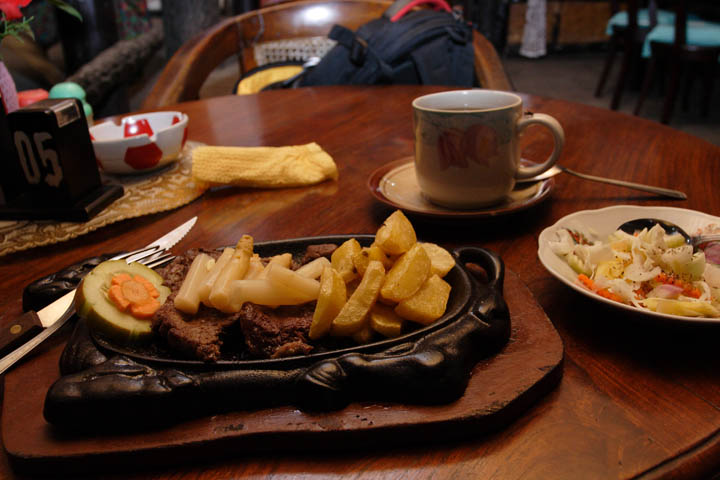
If you want to save money, the rule of thumb is: avoid tourist-oriented restaurants. Of course, if you are in tour group, you may have no choice. During my Kawah Ijen tour, we had lunch in a restaurant in Pantai Pasir Puteh. Nasi goreng (fried rice) and watermelon juice cost me 40,000 Rp. Compare this to the other meals I had in Java…

Note: Despite the pictures posted in here, I don’t consider myself a meat-lover.


My dinner in Probolinggo (Oct 27) consisted of ayam penyet (chicken), steamed rice and fruit juice. Total price: 20,000 Rp. The ayam penyet tasted better than the franchised variant in Malaysia…


I had mie pangsit (noodle) and bakso on my first day in Malang. I couldn’t believe how cheap they were – each of them cost Rp3,500. I suspect ‘bak’ was derived from Hokkien (Southern Fujianese) and means ‘meat’…


On my second day in Malang, I had my lunch in Ikan Bakar 52. Despite its name, this resto served more than just grilled fish. I ordered ayam taliwang (chicken), tofu and steamed rice. They came to a total of 27,600 Rp…


Before my return flight to Malaysia, I had my dinner in Surabaya Airport. I ordered rawon, a type of meat soup. I don’t remember its unit price, but together with steamed rice and drink, they came to a total of 46,000 Rp…


Street food vendor in Probolinggo…


Mobile bakso stall in Malang…


Bakso must be the national street food of Indonesia. Even President Obama publicly said that the Indonesian food was tasty…


Saturday, December 18, 2010

Java Trip (XI)

Chinese Indonesians

Chinese Indonesians have been systematically discriminated since the eras of Sukarno and Suharto. During the 1998 riots, many Chinese Indonesians were killed, and women raped. Situation may have slightly improved in the last few years: learning of Chinese language is now allowed; Chinese New Year has been made a public holiday; former President Abdurrahman Wahid even publicly admitted his Chinese root.

The desire to know more about Chinese Indonesians was what prompted me to visit the ‘Chinatown’ of Surabaya. To my disappointment, few of them still lived there…

A few days later, when I was in Malang, I learned from my Lonely Planet that there was a Chinese temple. I made the effort to visit it.

In Eng An Kiong Temple (永安宮), I finally came face-to-face with Chinese Indonesians. Unfortunately, I was too shy to communicate with them. (They probably thought I was one of them.) The temple was more than just a place of worship – I saw teenagers practicing table tennis in the compound.

Actually, majority of Chinese Indonesians were Christians, but I didn’t know which churches they go to. (In any case, churchgoers were more likely to tell me the story of Yesus rather than their own stories.)

So, my objective of learning more about Chinese Indonesians was not met. Anyway, I wish them a better future. I pray for them…


A Chinese restaurant:


Eng An Kiong Temple:

Teenagers playing table tennis inside the temple:

Saturday, December 11, 2010

Java Trip (X)

Malang’s Architecture

Architecture photography has never been my cup of tea. In my trip to Malang, however, I decided to shoot pictures of buildings. I did so specially for one person – Kyh – our budding architect.


Balai Kota – City Hall:


A church:

Jesus is Yesus in Indonesian:


Another church:


A mosque:


Not sure what this building is:


Monday, December 06, 2010

Java Trip (IX)


Malang – the city of Bad Luck

I was bemused by the name of this city in East Java, as malang means ‘bad luck’ in Indonesian.

My initial plan for the Java trip was to return to Surabaya in the fifth day. However, after spending my first day in Surabaya, I changed my mind and decided to go to Malang instead. It turned out that Malang was a nice place to spend a day or two.

No, Malang couldn’t compare to Bromo or Ijen. But if you are running out of Rupiah, you can withdraw money from ATM using your credit card.

If you want to buy souvenirs for your family or friends, Sarinah Department Store near alun alun is a good place to stock up.

If you are fed up with tourist-oriented restaurants which serve lousy food at bloated price, there are some fine eateries in Malang. My pick: Ikan Bakar 52 near Carrefour. (It serves more than just grilled fish.)


Splendid Inn

As a budget traveler, I always tried to be kiamsiap (stingy). Throughout the Java trip, I had been staying in budget hotels. On the final night, I decided to let loose and pamper myself with a better room. Nonetheless, for the sake of Mother Earth, I said ‘no’ to air conditioning. My choice in Malang: Splendid Inn. A fan-cooled room cost 190,000 Rp.

Pros:

Good room at affordable price; decent breakfast served from 6.00am; strategic location


Cons:

Rooms need maintenance

Friday, December 03, 2010

Indonesia – the Next Economic Powerhouse?

Nine out of ten Malaysians who read the title of this post would think I am crazy. Indonesia is a poor country plagued by natural disaster, terrorism and racial conflicts. Its men work in Malaysia as construction site workers, and its women as domestic helpers. How can Indonesia ever be an economic powerhouse!??

Well, if you don’t trust me, you should at least take a hint from Datuk Seri Tony Fernandes, founder of AirAsia and an idol among many Malaysians. Fernandes told Bloomberg TV in an interview that the airlines’ Indonesia business may surpass its Malaysian unit “in the not-so-distant future”.

His remarks hardly surprised me. Indonesia has a population of 238 million, making it the 4th most populous country in the world. Its GDP is $670 billion. (Malaysia’s is $213 billion.) IMF estimates that Indonesia’s GDP will grow at 6% in 2010 and 2011, a very commendable figure. Indonesia is a large, untapped market, which was why Fernandes was optimistic of it.

Indonesia is also a member of Group of 20 (G20), while Malaysia is not. Some observers have added the island nation into the rank of BRIC (Brazil, Russia, India, China). These five emerging economies are collectively known as BRIIC. A 2008-issue of Newsweek described Indonesia as ‘the new India’. More recently, a Taiwanese magazine (天下雜誌) pointed out that Indonesia, together with Vietnam, are the two bright spots in Asian economy.

So, don’t look down on your Indonesian maid. Ten years from now, we may need to kowtow to Jakarta, much like we kowtow to Beijing now.


Monday, November 29, 2010

Java Trip (VIII)

Kawah Ijen

With the Bromo Sunrise Tour coming to an end at 8.30am, I set sight on my next stop – Kawah Ijen, or Ijen Crater.

The tour operator picked me up at Yoschi Hotel at 10am. There were three other participants – two Belgians and an Australian. Kawah Ijen was pretty far away, and the access road was VERY BAD. We spent that night at a coffee plantation in Sempol.

The following day we woke up at 3.30am, had breakfast at 4am, and check-out from the hotel at 4.30am. At around 5 in the morning we reached the Ijen National Park. From the entrance, we had to walk 3km up the hill.

Before I left for Java, someone had already warned me that the 3km hike to the rim of the crater would be very tough. I did everything I could to reduce the weight of my bag: The 908-page Lonely Planet and one of my two lenses were left in the car; I had eight AA size batteries. The Australian lady happened to need AA batteries, so I happily loaned four to her.

Unfortunately, I made a mistake for not bringing a raincoat or umbrella. It started to rain as we were ready to set out, and I had to look for shelter. The Austrian lady, who had an umbrella, was way ahead of me. I almost wanted to ask her, “Can we share the umbrella?”

It took me more than an hour before I made it to the rim of the crater. My efforts paid off, as I was presented with a view which marveled me. I took picture with great care. The wind was strong. I was concerned that I would be blown off the ground and tumble into the crater.

Kawah Ijen also produced sulfur. Workers transported loads of sulfur from the crater to the foot of the hill. It was a tough job which paid very little. I was told that the workers got 600 Rp for every kilogram they carried.

By the way, I was proud to be the only visitor who was neither Westerner nor Indonesian on that day…


Sulfur collectors:


The sign reads: All visitors strictly forbidden to go down to the crater… (But the sulfur collectors kept persuading us to descend.)


Two baskets of sulfur:

Tuesday, November 23, 2010

Java Trip (VII)

The Belgian tourist with an Indonesian student

How Indonesians learn English

I joined a package tour to Kawah Ijen immediately after the Bromo tour. There were a total of four participants – two Belgians, one Austrian, and me.

We stopped at a resto in Pantai Pasir Putih for lunch. As we were waiting for our food to be served, a group of students entered the premises and started to chat with the Westerners. It turned out that their teacher wanted them to practice their English with foreign tourists. (My Austrian tour mate told me that she had similar experience elsewhere in Indonesia. It looked like such practice was common throughout the island nation.)

These students even asked for the e-mail addresses and Facebook accounts of the Westerners…

But I was left fuming, “WTF, do you think I don’t speak English!??”


Thursday, November 18, 2010

Java Trip (VI)

Up Close with Mt Bromo

After viewing Mt Bromo and the surrounding landscape from the top of Mt Penanjakan, we rode the jeep downhill at around 6am. The second half of the tour – scaling the volcano.

But first we had to cross the Lautan Pasir, or Sand Ocean. Tourists who did not want to walk on foot could get a horse ride, at a fee. Near the foot of the volcanic cone, there was a stairway to the rim of the crater. Lonely Planet said the stairway had 253 steps, but other sources gave 246, 248, or 250. Horses would stop here, so tourists must rely on themselves for the final part of the journey.

There was a Hindu temple on the Sand Ocean. It is worth noting that natives of the area were mostly Hindus.

Again I will let my photos do the talking…


This is the jeep I rode for my Bromo tour:


Stone markers show the way to Mt Bromo:


Horse ride on Lautan Pasir:


Advancing to Mt Bromo:


Hindu temple:


Stairway to the summit:


Fumes from the crater:

Monday, November 15, 2010

Java Trip (V)

Bromo Sunrise Tour

On the second day of my Java trip, I woke up at 5am. Some readers of this blog were exclaiming, “Oh, that’s so early!” Well, I had to wake up at 3am on the following day for the Bromo Sunrise Tour.

By 3.30am, I was at the front desk. A jeep came to pick up the participants. There were four of us. We proceeded to Cemoro Lawang, where two more tourists joined the group. We were then driven to the top of Mount Penanjakan. At 2,770m, Mt Penanjakan provided the best viewpoint for Mt Bromo (2,329m) and its surrounding landscape.

Before my flight to Java, I already learned that temperature on Mt Penanjakan could drop to 5C in the morning. I was well prepared by wearing 4 layers of clothing, including a jacket rented from Yoschi Hotel. Beneath my jeans was a pair of thermal undergarment. I also wore a winter hat which I bought the day earlier. But it turned out that the temperature wasn’t as cold as I thought. Maybe it was especially warm on that day; maybe it was because of the crowd…

I will let my pictures do the talking…


Shops on Mt Penanjakan:


Before sunrise:


(near to far) Mt Batok, Mt Bromo (belching smoke), Mt Semeru:


This place was full of people 30 minutes earlier. When I took this picture the crowd had dispersed:

Friday, November 12, 2010

Java Trip (IV)

Yoschi Hotel

Cemoro Lawang (sometimes written as Cemara Lawang) was the last settlement before Bromo-Tengger-Semeru National Park, the highlight of my Java trip. Many tourists spent the night here. Unfortunately, hotels in Cemoro Lawang were a bit pricey. As a traveler on a shoestring, I always tried to be kiamsiap (stingy). After doing research on the Web, I decided to book a room in Yoschi Hotel, a few km down the hill at Ngadisari.

Yoschi Hotel offered four types of accommodation: Economy Room, Standard Room, Deluxe Cottage and Family Cottage. I chose an Economy Room, at 104,000 Rp per night. The room did not have attached bathroom, but I could use the hot shower in the garden.

It is worth noting that October was considered low season in Yoschi, but high season in Cemoro Lawang’s hotels.

Here are some pictures of Yoschi Hotel:

My dinner in the hotel – Steak with asparagus:


Now, the verdict…

Pro:

Price is very competitive; atmosphere is great; its restaurant serves good food; the staff are also very helpful.

Cons:

The location isn’t the most convenient: you can’t see Mt Bromo from Ngadisari; there were no wartel (shop for making long distance calls) nearby, and warnet (Internet shop) was 3km down the hill at Sukapura.


Useful information:

Yoschi’s webpage

e-mail: info@bromosurrounding.com

tel: +62-813 3636 5438, +62-857 4988 0299


On the business side:

Yoschi’s rooms were relatively cheap, but it made money from side businesses, e.g. restaurant. Jackets were available for rental at 25,000 Rp each, and I bought a winter hat for 10,000 Rp.

Monday, November 08, 2010

Java Trip (III)

The Road to Bromo

It was 5am, Oct 25, 2010. I was awakened by the caw of a cock. Can you imagine that I was in the second largest city of Indonesia?

My next stop for the East Java tour was Mount Bromo. But for that, I need to get to Ngadisari, a few kilometers from the volcano.

When I checked in to Orchid Guesthouse the previous day, I learned that complimentary breakfast would be provided. Unfortunately, it wouldn’t be served until 7.30am. Wanting to get to Ngadisari early, I decided to check out at 6.30am, and had my breakfast in Purabaya Bus Terminal instead. (By the way, 7.30am was relatively late in East Java. Splendid Inn, which I would stay in four days later, served breakfast starting from 6am.)

I took a public bus from Purabaya to Probolinggo. Along the way, I saw many paddy fields. Java, fertilized by volcanic ash, was an important rice producer…

Paddy field in Java…


At Probolinggo, I changed to minibus. The minibus attendant told me that the fare to Ngadisari was 25,000Rp. There was a catch, though – the bus wouldn’t leave Probolinggo until it was full.

One hour had passed, there were still insufficient passengers. The attendant came to tell the passengers that the minibus would leave in a while, with 2/3 of the seats filled. But the fare would increase to 40,000Rp. (WTF!) Judging that there were no feasible alternatives, I had to accept the offer.


Minibuses to Bromo…

Well, the minibus was not full when it departed Probolinggo, but it continue to pick up passengers along the way. At one point, there were about 20 passengers in the vehicle. Junior high school students, all girls, clung onto the outside of the bus precariously as it cruised along. (See picture below. The guy in black is the minibus attendant.)


After about 1 ½ hour, the minibus reached Ngadisari. I asked to be dropped off at Yoschi Hotel, where I would spend the night. The bus proceeded to Cemoro Lawang, the last settlement before Mount Bromo.

I will write more about Yoschi Hotel in the next post. Now let’s look at some pictures shot in Ngadisari…