Tuesday, December 31, 2013

Vietnam in 2005 & 2013

In 2005, I was sent by my company to Ho Chi Minh City several times. Then, in 2006, I quit the company. After an 8-year hiatus, I finally decided to return to Vietnam, though this time for vacation.
What have changed in Vietnam in these 8 years? And what have not?

What have not changed

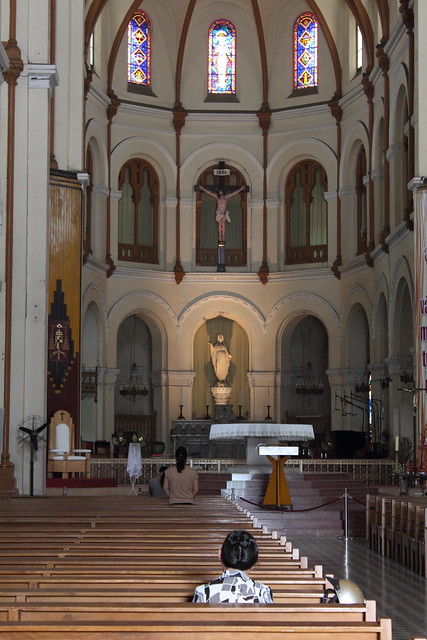
The Notre Dame Cathedral, Central Post Office, Opera House and People’s Committee Building in Saigon all have retained their charm. And the traffic in Saigon is as scary as ever…

Notre Dame Cathedral
What have changed

Vietnam’s Highway 1A runs from China-Vietnam border in the north to the Mekong Delta in the south. But make no mistake, this so-called highway is similar to Malaysia’s national trunk roads, where drivers share road with motorcyclists, cyclists and pedestrians.

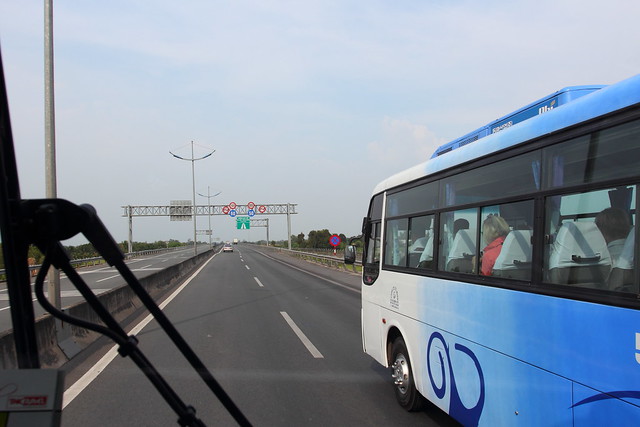
In 2010, Vietnam finally had a ‘real’ expressway – the HCMC-Trung Luong Expressway. The expressway connects HCMC with the Mekong Delta region, shortening the travelling time by about 30 minutes. The expressway still had not been extended to Can Tho, the largest city in the Delta. But I am sure eventually it will.

HCMC-Trung Luong Expressway
Between the 40s and 80s of the last century, economy of Vietnam stagnated because of war and communist policies. It is catching up now…


By the way, I saw more pretty women in Saigon than there were 8 years ago. I guess this was because Vietnamese women could afford to spend more on cosmetics and skincare products, yet another sign of the nation’s rising income.

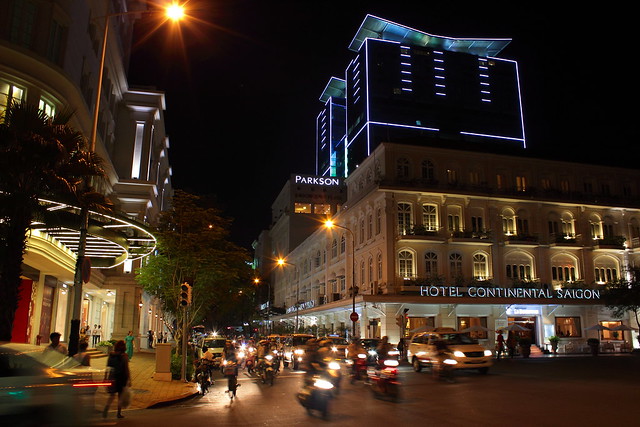
Saigon at night
Thursday, December 12, 2013

Vietnam Airlines

I am back from my vacation in Vietnam! And, as promised, I will tell you more about Vietnam Airlines…

One thing which bugs me, and many other passengers, is that Vietnam Airlines like to re-schedule its flights. To its credit, VA does inform the passengers through email a few weeks in advance. In my case, the KUL to SGN flight was re-scheduled from 2:00pm to 12:30pm. This was actually a boon for me as I had more time on Vietnam soil. But be careful if you have connecting flight. A change in flight schedule could potentially turn your plan upside down.

Having flown mostly with budget airlines in the last few years, the first thing I noticed, in fact expected, upon entering the cabin was the much larger legroom. I no longer had to press my knees on the seat in front of me, LOL…

During take-off and landing, the cabin crew sat near the emergency exits. In doing so, Vietnam Airlines sacrificed two seats which would otherwise be sold to the passengers. I am sure the kiamsiap (stingy) Tony Fernandes would never do this.

The food served during the flights was just normal, certainly no match to the food I tasted in Saigon. But at least it was complementary.


As a conclusion, Vietnam Airlines is far from perfect. (I have already mentioned, in my previous post, that its online booking mechanism is not user-friendly.) But if the price is right, I would certainly recommend it.

Flying over Mekong Delta

Tuesday, September 17, 2013

My upcoming trip to Vietnam

I will go for vacation in Ho Chi Minh City aka Saigon later this year.

The reason I choose HCMC over other destinations is that Vietnam Airlines offers ‘Super Saver’ fare. My round trip airfare, inclusive of airport taxes, is RM335. Had I gone with Air Asia, the airfare, including airport taxes, but excluding travel insurance, would set me back at least RM588.

So much of a budget airline!

Of course, if I booked my flights 6 months in advance, AA’s fare could still cost less. In addition to this, it has other advantages over VA: AA’s online booking system is more user-friendly. It has four daily flights from KUL to SGN; VA has only two. Do note, however, that AA’s flights at ‘more convenient times’ tend to be more expensive.


I will tell you more about Vietnam Airlines after returning from my trip.


Thursday, May 02, 2013

1967 Malaysian Movie

Mat Bond, released in 1967...


As the name implies, this is a story about James Bond - Malaysian version.

Note that the two actresses wear bikini. You won't see bikini-clad women in today's Malay movies. This country has become more conservative in the last few decades.

And, after Malaysia's 13th General Election on May 5, 2013, we probably won't be seeing women's hair in locally-produced movies anymore...


Wednesday, April 17, 2013

Fitness & Health


How to be healthy? Any sports enthusiast will tell you to exercise. Not just any exercise, but those rigorous, heart-pumping cardio. Recently, in a Malaysian Internet forum, a guy dismissed walking as “useless”.

In the West, some fitness experts pointed out that yoga is ineffective for weight loss, since it doesn’t burn as much calorie as running or spinning. But they are unable to explain why long term yoga practitioners tend to have lean figures.

Which makes me wonder: Does fitness equal health?

Okinawa in Japan has some of the longest living people in the world. Scholars attribute the long life expectancy of the Okinawans to their diet and active style. However, I doubt many of them still do karate fighting at the age of 80.

Hong Kong is another place with very high life expectancy, and scholars attribute it to the fact that Hongkongest walk a lot. Unlike Malaysians and Americans who are terribly car-dependent, Hong Kong people often ride train (MTR). However, walking to and fro the MTR station is not cardio exercise. Taichi is popular in this Southern Chinese city, but again it is not a cardio exercise. (Taichi does have some “fast forms”, which are rigorous, but they are not commonly practiced.)

Fitness is essentially a Western concept. There is no Chinese translation for the English word ‘fit’.

Fitness is external; health is internal. Fitness is generally associated with physical exercise, such as running, swimming and weight lifting; health is related to many more factors, such as diet, nutrition, therapy and mental wellness.

American researchers recently compared data from two studies of 33,060 runners and 15,045 walkers. Their findings could surprise many of us. Results showed:

The risk for first-time hypertension was reduced 4.2% by running and 7.2% by walking.
The risk for first-time high cholesterol was reduced 4.3% by running and 7% by walking.
The risk for first-time diabetes was lowered 12.1% by running and 12.3% by walking.
The risk for coronary heart disease was lowered 4.5% by running and 9.3% by walking.


So, would you say “walking is useless”?


Monday, March 11, 2013

Squatting for Sexy Butt


In her column, Malaysian fitness expert Fiona Ho writes that the best way for a woman to tone her butt is by squatting. (Sunday Star, March 10, 2013)

Mention squatting, the first thing which comes to mind is the traditional Asian squat toilet. I found it hard to relate squatting to beauty…

When Hong Kongese and Mainland Chinese engaged in the locust-dog squabble last year, a magazine (亞洲周刊) pointed out that there exist cultural differences between the two people. One of them was that the Mainlanders liked to squat. So, do you see many Chinese women with big, firm, round butts?

Squatting exercise


Tuesday, February 05, 2013

Myanmar, anyone?


I plan to visit Myanmar this year. As traveling in this country, which emerged from decades of isolation just recently, is a bit troublesome, I would like to look for a few partners to share the burden. If you are interested please contact me.

A bit of background information

Myanmar has the so-called ‘Big 4’ destinations, namely Yangon, Mandalay, Bagan and Inle Lake. Yangon is in Southern Myanmar, while the rest are in the Central Region. Visiting all four of them would take more than a week. Air Asia flies to Yangon only.

Myanmar is largely a 'cash only' economy, with very limited use for credit cards. Advanced booking of domestic travel must be done through local agents. All foreign visitors need visa to enter the country.


My initial plan is to go there in June, and will spend most of the time in Yangon. Duration is 4 or 5 days. However, if I can find travel companions, I may decide to visit more places...

P/S This will be a budget trip.


Thursday, January 17, 2013

My Struggle with Yoga


Wanting to improve my flexibility and posture, I decided to take up yoga a couple of months ago.

Before joining the class, I was concerned that the pretzel-like poses in yoga would be too tough for me. Fortunately, I managed to set aside my fear. Now, having practiced for a couple of months, I am happy with my progress. I have also realized that (almost) everyone can do yoga.

As you probably already know, there are dozens of, perhaps more than a hundred, poses in yoga. (Poses are known as asana in Sanskrit.) On top of these, there are ‘variations’ to the classic poses. If one finds the classic poses too tough, he/she can always try the variations.

More importantly, we should practice at our own pace. Do not try to match the other students in your class. And guys, don’t try to impress the girls by performing Headstand or Crow before you’re ready!

Tree
This popular pose is often seen in photos…

Triangle
This pose is quite challenging. My lower hand still cannot reach the floor yet.


Child
This pose is often practiced for relaxation. Unlike other forms of exercise, relaxation is integral to yoga.


Corpse
Surely everybody can do this. No?


Thursday, December 20, 2012

Air Purifier


Happy End of the World!

I bought an air purifier lately. You know, the air in Kuala Lumpur is polluted. An air purifier – sometimes called air cleaner – removes contaminants from the air, and helps boost our health.

There are many types of air purifiers in the market. If you are shopping for one, but are confused of the various technologies used, I give you some clues here…

HEPA Filter

HEPA stands for High Efficiency Particulate Air. An air cleaner using HEPA filter removes up to 99.97% of 0.3 micron particles. This is the most commonly used technology.

One drawback of this technology is that HEPA filters need to be replaced after a year or two, and they are costly.

Ionizer

Ionizers disperse negative ions into the air. These ions attach to airborne particulates. The electrically charged particulates in turn bond with each other and settle to the floor or wall.

Moisture discharges the ions. Therefore, this technology is less effective in humid places. In Malaysia, this essentially means ionizers only work inside air-conditioned rooms.

Another concern is that ionizers generate ozone, a lung irritant.

Water-based Air Refresher

A water-based air refresher, like the one shown above, sucks air into the water. Presumably the pollutants will dissolve in the water.

I have got one such device. I found its air flow to be quite weak, compared to a typical air purifier with HEPA filter. While I observed that the water was dirty after a day in use, it was not as effective as I wish to be.

Note that I added aromatherapy solution to the water, and the air which came out of it was very revitalizing. This device failed as an air cleaner, but it did serve other purposes.

Tuesday, November 06, 2012

Now Everyone Can Drive an SUV


(source: Wikipedia)

Tony Fernandes, the founder of budget airline AirAsia and budget hotel Tune Hotel, has teamed up with Renault to produce sport utility vehicles (SUV).

I expect Tony to give us the cheapest SUV in the market. But the base model will be without air-conditioner, music player, power steering, power windows, air bag, cup holders and spare tyre. You may add some or all of these items – at additional charges.

Also, Tony will not appoint resellers for the SUV. You place order online and pick up your vehicle from the warehouse. Alternatively, pay a fee for it to be delivered to your doorstep.

Are you excited?

Wednesday, September 19, 2012

Uniquely America


Many years ago, when I was working in the US, I had a co-worker who came from China. One day, when we were having a chat, the Chinese guy said, “The US is different from the rest of the world.”

To some degree, he was right. Take, for example, measurement units: the world has adopted meter, kg and Celsius for a long time; Americans stubbornly cling to foot, pound and Fahrenheit. (I must admit that properties in Malaysia are still measured in square feet. The developers are probably concerned that switching to metric system would affect their sales.)

Back then, mobile phones in the world mostly ran on GSM networks. American carriers used a mix of GSM and homegrown technologies such as D-AMPS. It is worth noting that SIM card was essentially a European invention which is absent in American-developed D-AMPS, CDMA2000 and WiMax. The Americans never quite understand why we need it. Some think that we could simply store our PIN online rather than on the SIM card. But beware: if someone steals your PIN, he/she could make free calls while you bear the cost. Hardware authentication should be more secure.

Apple has just launched iPhone 5. The general consensus among the techies is that the iPhone 5 is a worthy upgrade of its predecessor, but lacks ‘wow’ factors. Yet it sells like hot cake – at least in the US. Take a look at the pie charts below…


- - - - - - - - - -


P/S: In case you are unaware, the tagline for Singapore tourism is Uniquely Singapore.

Friday, August 17, 2012

Apple – losing its mojo?


I had a gathering with my MBA coursemates two weeks ago. There were seven of us. Aside from one who still used an old Nokia cellphone with physical keyboard, there rest all had Samsung. No a single one of us had an iPhone…

Just two years ago, iPhone was the must-have item among gadget lovers. Today, it is being challenged by the Android phones in general, and Samsung Galaxy in particular. Last quarter (Q3 FY12), Apple sold 26 million iPhones, a significant drop from the 35.1 million in the previous quarter. While Tim Cook, CEO of Apple, attributed the dismal sales to consumers holding out for the next-generation iPhone, I suspect there were other factors at play.

Of course, iPad still dominate the tablet market, and Apple will soon strike back with iPhone 5 (the new iPhone?). Let’s see if the Fruit Empire will be able to regain its past glory.

Tuesday, May 29, 2012

Moxibustion


Some time ago, I wrote about acupuncture in my blog. Acupuncture is effective in treating certain syndromes, but not everyone is comfortable to prick needles into his/her skin. There is an alternative: moxibustion (艾灸).

Moxibustion works in the same principle as acupuncture, except that it uses heat instead of needle. There is subtle difference, though. Traditional Chinese Medicine is based on the principle of yin and yang. Moxibustion is most suited for treating syndromes caused by deficiency of yang, e.g. menstrual pain. As for whether it can used to treat syndromes caused by too much yang, e.g. fever, the books I read seem to give different views. In such situations, it is advisable to consult qualified TCM doctors.

In Malaysia, you can buy ‘moxa rolls’ from Beijing Tongrengtang (北京同仁堂). The moxa rolls produced a lot of smoke, and not everybody likes it. There are also some ‘smokeless moxa rolls’ sold in China. I intend to order them online.

Wednesday, February 08, 2012

Symphony of Lights – in Malaysia!

People who have visited Hong Kong must be familiar with the show known as Symphony of Lights. The show is played at Victoria Habour at 8 o’clock every evening.

In conjunction with Lunar New Year 2012, Thien Hou Temple in Kuala Lumpur had staged a similar show. Though on a much smaller scale, the show was no less interesting…


The temple…


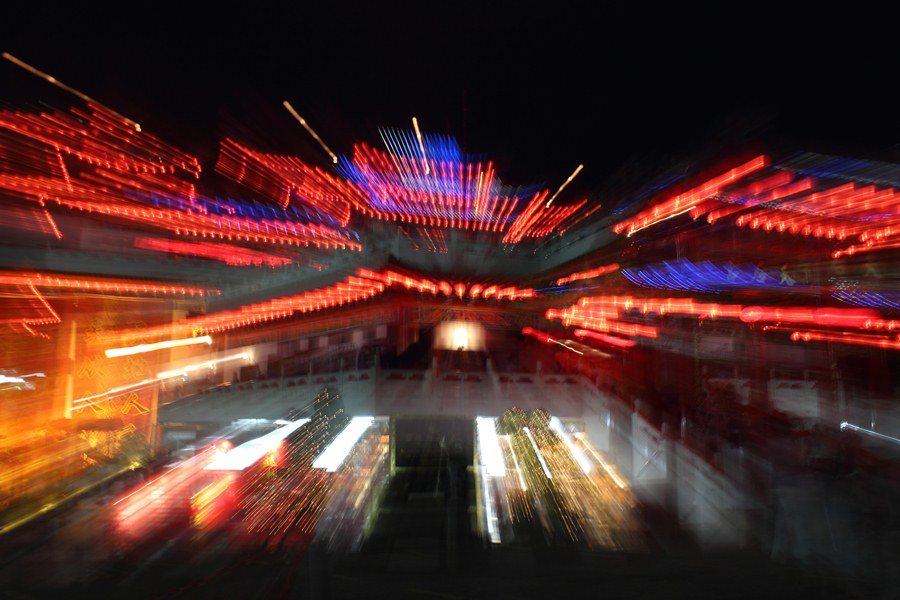
Playing with zoom…


Here you go, the show of lights…


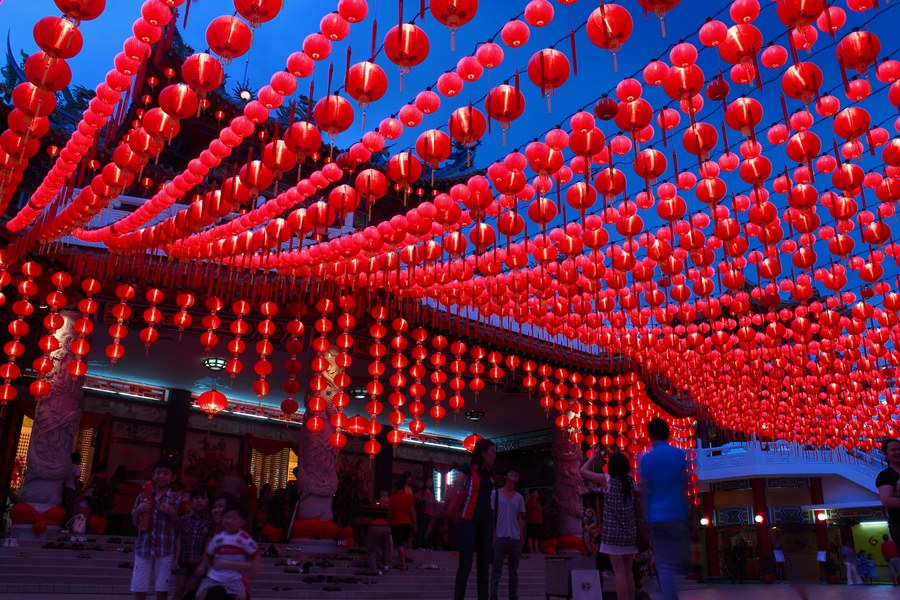
As in the past years, Thien Hou Temple was decorated with large number of lanterns…


One thing I like about Thien Hou Temple is that devotees are told to burn just 4 joss sticks – one for the Deity of Haven, and one for each of the three in-house deities. Traditionally, Chinese burn 3 joss sticks for every deity. By burning fewer joss sticks, Thien Hou Temple is considerably less smoky. This is good for the health of the people and the environment…


Friday, February 03, 2012

In praise of Introverts


The February 6, 2012 issue of Time Magazine features an article: The upside of being an Introvert. As I am an introvert, this article immediately caught my attention.

Our society has not been very kind to the introverts. People don’t pay so much attention to us; and we are less likely to be successful salespersons – that is, unless we sell online. However, according to the Time article, introversion is not all bad. Throughout history, there have been many great people who are introverts. See the list below:

Introverts

  • Mohandas Gandhi
  • Joe DiMaggio
  • Moses
  • Hillary Clinton
  • Warren Buffett
  • Manmohan Singh
  • Bill Gates
  • Mother Teresa
  • Barack Obama

Extroverts

  • Bill Clinton
  • Margaret Thatcher
  • Steve Jobs
  • Boris Yeltsin
  • Marie Antoinette
  • Muhammad Ali
  • Winston Churchill
  • George W. Bush

It is worth noting that America’s two richest men – Bill Gates and Warren Buffett – are both introverts. Among athletes, Joe DiMaggio (baseball player) was an introvert, while Muhammad Ali was an extrovert. Former President Bill Clinton is extroverted, but his wife Hillary is introverted.

The author also says that introverts often prefer to express themselves in writing. Maybe that’s why I am blogging here…


Wednesday, January 18, 2012

How to Pick Stocks

In one of my previous posts, I wrote about the investment strategy of Peter Lynch, an American fund manager. Some of you are probably interested in it, and want to learn more.

I recently bought the stocks of Padini, an apparel maker. I made the purchase based on the guidelines given by Lynch. Now I will tell you how I came up with this decision:

  • In the past few years, Padini’s revenue has been growing at about 9% annually, and profit has been growing at more than 20% annually.
  • P/E ratio was about 9.5, which wasn’t too expensive. (According to Lynch, if the profit growth doubles the P/E ratio, the stock is a bargain.)
  • The company has more cash than debt.
  • PADINI is not a hot stock. (Hot stocks tend to be riskier.)
  • We buy clothes even when economy is bad.

Of course, I am not an investment guru; I may be wrong. The picture is not all rosy. For one, Padini’s brands are relatively weak. Uniqlo, the Japan-based apparel maker, has a much stronger brand. Then again, Uniqlo may not pose a serious threat. Clothes sold by Uniqlo are often too warm for Malaysian climate.

Note:

P/E ratio is short for Price/Earning ratio. We compute P/E ratio by dividing the stock price with earning per share.


Thursday, January 05, 2012

My Hong Kong Trip (VI)

Recycling in Hong King

Recycle bins are common sight in Hong Kong. Here are some…

In Ocean Park…


In Hong Kong Convention & Exhibition Center, Wanchai…


Foreigners in Hong Kong

Before visiting Hong Kong, I already knew that there were many Filipino workers in the Chinese territory. It turned out that there were plenty of Indonesians too.

While Filipinos congregate in Central on Sunday, Indonesians do so in Causeway Bay, not far from my hotel. I later learned that Thais meet at Tsim Sha Tsui.


Indonesians in Causeway Bay…


Hong Kong Girls

I didn’t see many pretty girls in Hong Kong. Which came as a surprise, given that the SAR was an affluent and trendy city.

Occasionally I came across pretty girls. But chances were, they were Mandarin speakers…


No Clear Sky

As an avid photographer, I like to take landscape photos with blue sky. Unfortunately, during my 8-day trip to Hong Kong, the sky was almost always shrouded in haze. The wind had blown the polluted air from Mainland China to the SAR.


Colonial Era Place Names

Unlike Malaysian Government who wasted no time to rename most of the streets after independence, Hong Kong still retains many of the colonial era place names. We came across such names like Jordan, Nathan Rd, Wellington St, Shelter St...

I suspect Hongkongese miss the days when they were ruled by the Brits, especially when the two SAR chiefs, Tung Chee Hwa and Donald Tsang, disappoint them.


Sunday, January 01, 2012

One Up on KLSE


I am learning to invest in stock market, and I have just finished reading this book:

One Up on Wall Street, by Peter Lynch

Lynch is a former fund manager. He shares many similarities with Warren Buffet – both of them are long term investors who ignore short-term market fluctuation; both of them invest in companies, not in the market.

However, Lynch differs from Buffet in some other ways. Buffet likes to invest in companies with durable competitive advantages. Such companies would have very good track record; they would have been profitable for many years. The problem is: stocks of such companies won’t come cheap.

Lynch, on the other hand, groups companies into 6 categories – slow growers, stalwarts, fast growers, cyclicals, turnarounds, and asset plays. He has devised a strategy for each of these categories.

Lynch likens a potential fast grower to Harrison Ford. The Hollywood superstar was a carpenter before he joined the cast of Star Wars. A stalwart, on the other hand, is like a lawyer. A lawyer’s wagers, while high, don’t come close to Ford’s income.

In his book, Lynch guides on how to pick a winner, when to buy, when to sell etc…

After reading my post up to here, some of you are probably getting excited, and want to get a copy of this book. Those who have read this book may want to resign from your job and become a full-time investor. But let’s be realistic, can you become a millionaire by investing in stocks?

Let’s say your initial capital is RM10,000, and you invest in just one security. (Few people put all their eggs in one basket!) Within five years, the price of this stock rises by 10-fold. Your investment now values at RM100,000 – not bad at all! Even so, you’re still just a 0.1 millionaire.

I have invested in a few stocks, but I still can’t retire, yet…


Tuesday, December 20, 2011

My Hong Kong Trip (V)

Eating in Hong Kong

Hong Kong is foodies’ haven. During my visit to the SAR, we had a meal in the famous Yung Kee Restaurant (鏞記酒家).

Yung Kee is most famous for its roasted geese. Unfortunately, I haven’t got the picture to show here. I am not that kind of people who would say, “Don’t eat! Let me take some pictures and upload to Facebook.”

Anyway, I managed to snap a few pictures before we picked up our chopsticks…

Outside the kitchen…


Preserved eggs…


Roasted meat rice…


Yung Kee Restaurant is located at:

32-40 Wellington Street, Central, Hong Kong


Hong Kong is also famous for, what else, dim sum. And we also had a dim sum meal during our trip. Here is one picture…


But wait a minute… These are not real dim sum, but fridge magnets! We bought a few as souvenirs. I took picture after we returned to Singapore…


Friday, December 16, 2011

Free, with Terms & Conditions

Blogger SK wrote about a promotion campaign of KFC in Malaysia. The fast food giant offered free Zinger burgers for a month. Within a few hours after the promotion started, however, KFC had to discontinue the offer ‘due to overwhelming response’.

Is it possible for a business to offer some free goods or service, and still make money?

Well, AirAsia, the budget airline, has been giving away ‘free seats’ from time to time. But the passengers have to pay for everything else, from ‘convenience fee’ to baggage free to check-in fee.

In Japan, there is this kind of eateries called tachi-soba, literally ‘standing soba’. Patrons of these eateries are required to stand while having their meal. No seats are provided. See pictures below…

Source


Now, combining the concepts of AirAsia and tachi-soba, I am thinking of starting a restaurant which serves free noodles, but with terms and conditions…

  • Noodle – free
  • Service charge – RM5
  • Bowl – RM1 (you can bring your own bowl)
  • Chopsticks + spoon – RM1 (you can bring your own chopsticks)
  • Drinks – various prices
  • Chair – RM1 (you may stand)
  • Use of restroom – RM1

On the other hand, I would increase my revenue by selling ads space in the shop…

So, anybody want to join my new venture?